
విషయ సూచిక · 7 / 12
Reading the synchronized option chain
నవీకరణ 4 ఆగస్టు 2026 · 4 నిమిషాల చదువు · 16 విషయ సూచిక
సరళమైన అర్థం
Reading the synchronized option chain means examining option rights, obligations, chains, liquidity and the locally disclosed Black–Scholes sensitivities with the identity, period, unit, source and limitations kept visible. It is a disciplined way to describe evidence, not a shortcut to an investment conclusion.
Learning objectives #
After this chapter you should be able to define reading the synchronized option chain, identify the evidence needed to use it, distinguish a reported zero from unavailable evidence, and explain why unlike instruments or periods may not be comparable.
Prerequisites #
Read “Expiry, exercise, multiplier and settlement” first. Be comfortable checking an exact listing or instrument, its source, observation date, native currency and unit. When any one of those is unknown, pause the comparison and record the gap.
Core concept #
A chain is a cross-section for one underlying and expiry, not a collection of interchangeable rows. Preserve raw facts separately from interpretation, and retain the denominator, time window, classification rule and provenance that make the evidence reproducible.
Method #
For reading the synchronized option chain, first identify the exact evidence named in this chapter: A chain is a cross-section for one underlying and expiry, not a collection of interchangeable rows. Then freeze identity and period, collect source-backed inputs with units, calculate or classify only compatible evidence, and record contrary facts and unavailable fields.
Where it appears in XMarketRadar #
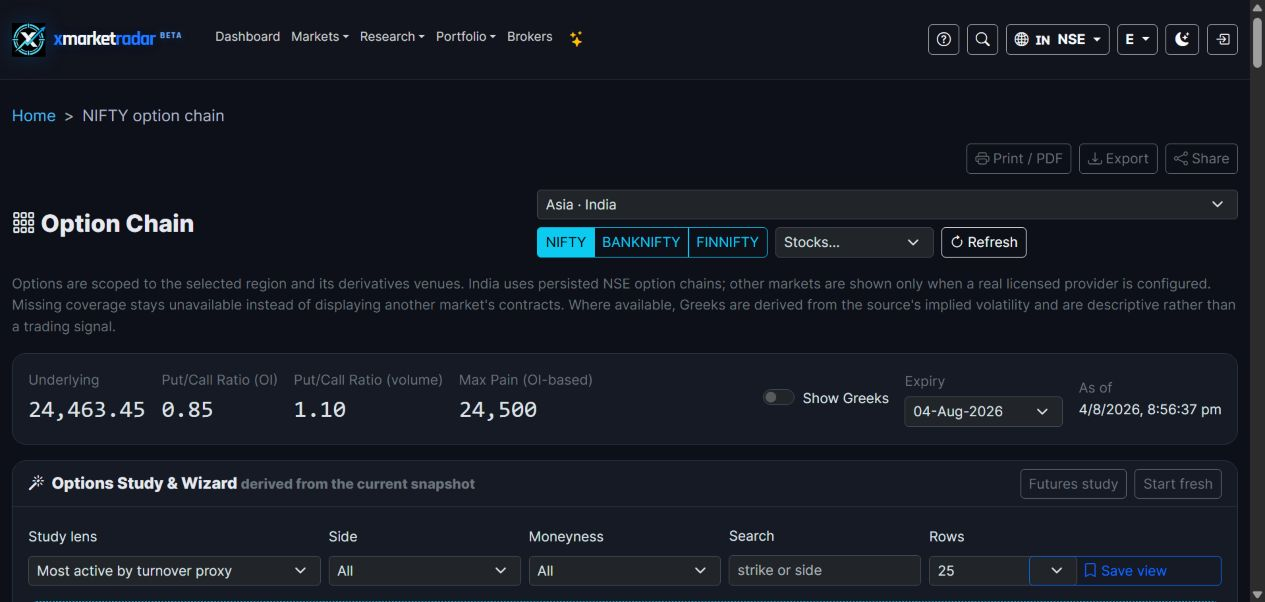
Use Option Chain and Options Screener persisted views; always retain underlying, expiry, strike, type, multiplier, provider IV and source/as-of status. A displayed field is useful only with its source and as-of context. If XMarketRadar does not calculate this chapter’s concept directly, use the chapter as an educational checklist and retain the supporting primary document or screen URL in the research workspace.
Worked example #
For 28-Aug expiry, strikes 95/100/105 share spot timestamp 14:00; a 25-Sep row is excluded. Module context: Illustrative XYZ 28-Aug-2026 105 call uses spot 100, multiplier 50, premium 3.20 and provider IV 25%; local Greeks use the fixed 7% risk-free assumption. This is an illustrative audit trail, not live data, a target or an expected outcome.
Interpretation #
Interpret the result in the direction defined by the field, not by an assumed desirable outcome. Higher, lower, positive and negative can each have different meanings by context. Compare the observation with its own history or a compatible benchmark, and label conclusions as observations, interpretations or user decisions.
Limitations and common mistakes #
Comparing Greeks from different timestamps as one surface. Discontinuous payoff, wide spreads, provider IV quality and local model assumptions make option metrics descriptive rather than predictive. A precise calculation can still mislead when the source is stale, the denominator changed, or a classification hides important detail.
Market and jurisdiction differences #
Multipliers, exercise style, expiries, settlement and position limits vary by exchange and jurisdiction. Exchange rules, accounting conventions, calendars, taxes, disclosure timing, quote scale and licensed coverage can differ. Verify the current primary source for the relevant venue; registry support alone does not prove that every field is available.
Key takeaways #
For reading the synchronized option chain, remember this boundary: Comparing Greeks from different timestamps as one surface. Keep the evidence exact, dated and source-backed; publish missing information as unavailable rather than manufacturing a value.
Practice #
Reproduce this historical scenario from source-labelled inputs: For 28-Aug expiry, strikes 95/100/105 share spot timestamp 14:00; a 25-Sep row is excluded. Then change one input, preserve the original period and unit, and explain whether the result changes or becomes unavailable. Write the identity, source, date, unit and failure condition, then state exactly what would display as —.
Knowledge check #
సమాధానం, వివరణ చూపు
Question: which mistake would invalidate a review of reading the synchronized option chain? Answer: Comparing Greeks from different timestamps as one surface. Explanation: the chapter requires the stated identity, period, unit and compatible evidence; a missing required input remains — rather than 0.
Educational use only #
This chapter is descriptive education, not investment advice, a forecast, a recommendation, a suitability assessment or an instruction to buy, sell, rebalance, trade or place an order. XMarketRadar’s broker connections remain read-only.